TCG Card Shop Simulator Beginner Guide
How the first week loop works in TCG Card Shop Simulator 1.0: which licenses to buy first, what to open, when to restock and where money comes from.
Written and sourced by TCG Card Shop DB Research Desk · independent fan project, not affiliated with OPNeon Games
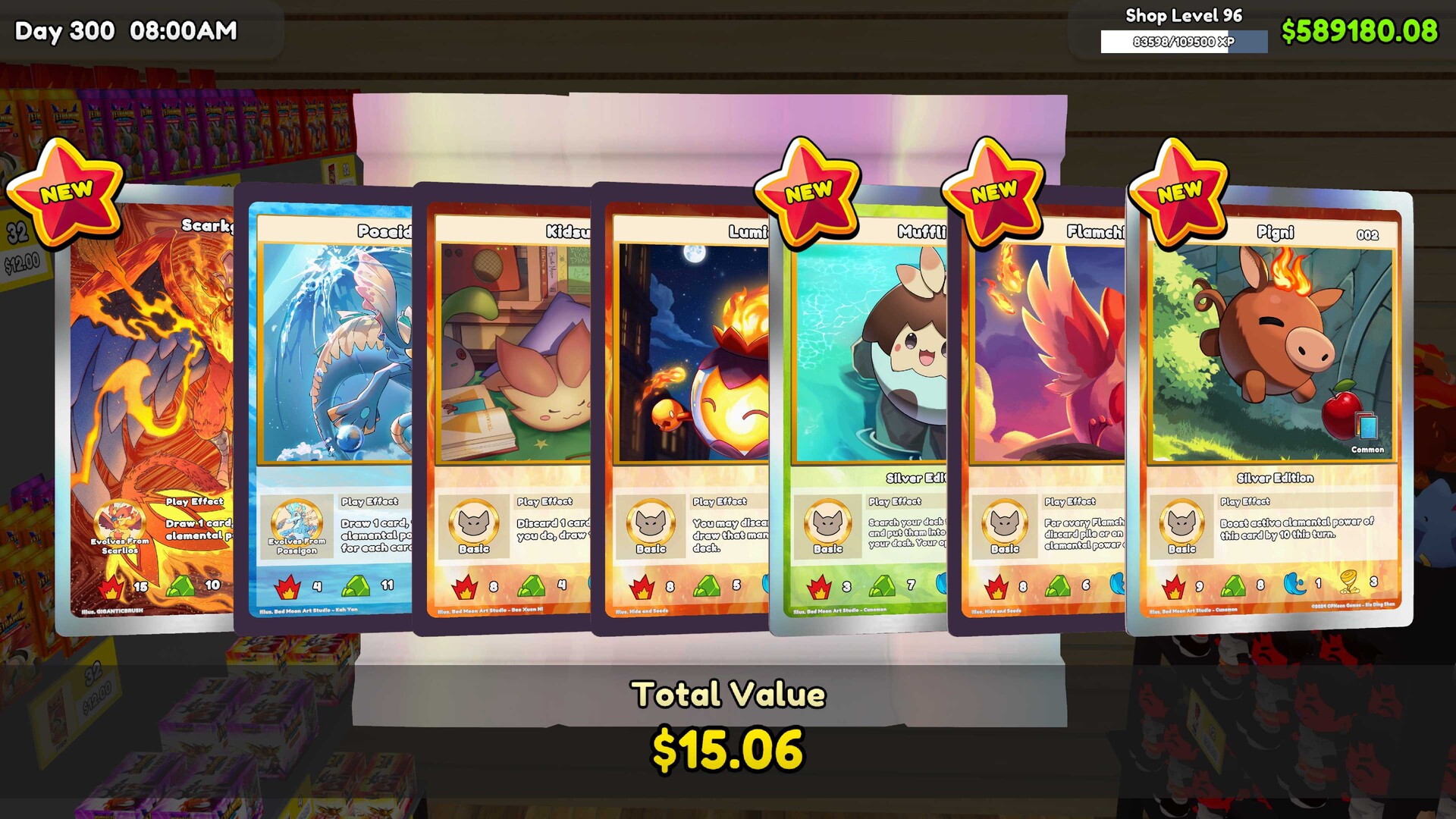 Official capture
 Direct answer
Sell packs through a manned register, keep every shelf compartment stocked, and spend profits on license levels instead of opening packs. Money arrives at checkout, from card tables, and from play table seat fees, and shop level unlocks everything else.
What the first week is for
Money enters your shop through exactly three doors: a checkout counter scanning packs and accessories, a card table selling singles, and a play table charging customers by the hour. Everything else is a cost until it unlocks. Shop level is the only gate that matters, because product licenses, staff, furniture and floor space all key off it, and level comes from the XP you earn by selling and opening.
Rule one for day one: sell the packs, do not open them. Opening converts cheap sealed stock into cards that look valuable in the album, but a card only pays out when a customer takes it off a card table slot, and slots are scarce early.
The license ladder to chase
Every product except the starter Basic Card Pack (32) needs a one-off license fee paid before it can be ordered again, and the fee is tied to your shop level, not to your cash.
| Product line | Shop level | One-off license fee |
|---|---|---|
| Basic Card Pack (32) | Always unlocked | None |
| Basic Card Pack (64) | 2 | $50 |
| Rare Card Pack (32) | 5 | $300 |
| Rare Card Pack (64) | 8 | $500 |
| Epic Card Pack (32) | 12 | $800 |
| Legendary Card Pack (32) | 20 | $2,000 |
| Basic Destiny Pack (32) | 25 | $3,000 |
Those level and fee pairs come from the wiki Stock Order tables, mirrored in the stock order ledger on this site. Read them as a map rather than a quote: what you pay per pack inside each box is rolled again when a save file is created, and the wiki states that plainly.
What opening actually returns
A pack holds 7 cards, and each character has 12 collectible variants once foils are counted. If you do open, these are the community figures, with the XP columns from the wiki level page and the pull column from the wiki card page’s per-10,000 expectation table.
| Edition | XP non-foil | XP foil | Copies per 10,000 |
|---|---|---|---|
| Base | 1 | 8 | 6,628.59 |
| 1st Edition | 2 | 16 | 1,657.14 |
| Silver | 6 | 48 | 720.50 |
| Gold | 8 | 64 | 375.26 |
| EX | 15 | 120 | 94.76 |
| Full Art | 18 | 144 | 23.75 |
Foil is a separate 1 in 20 roll layered on top of the edition. Ghost cards sit in the fixed 7th slot of a pack: 1 in 1,000 in a Tetramon Base pack, 1 in 500 in a Destiny pack, and 1 in 20,000 or 1 in 10,000 for the foil versions. The pack odds calculator runs those numbers over any pack budget.
The honest read: pulling a Full Art is a 0.24% event per card, so pack opening is XP and entertainment, not a business model, at low levels.
When to restock
Restocking is a demand problem before it is a time problem. Customers arrive with a shopping list only sometimes, and the list is drawn from what your shelves actually hold. The wiki mechanics page records the split: at level 1 to 2, only 5% of customers spawn with a list and it needs 3 shelf items present; at level 10 to 19, 25% arrive carrying a list of 4 items with 5 on the shelves; at level 30 to 39 it is 40% of customers and 9 shelf items. An empty compartment turns a listed customer into one who wanders to a random shelf and says they cannot find it.
Practical rhythm for the first week:
- Restock and open packs before you open the doors. The community bills page notes the light meter keeps running after 9 PM, so daylight work is free work.
- Stand on a register yourself and let the staff stock. Customers check a player manned register with an empty queue first, then NPC manned registers, then the shortest line.
- Hire at the level gate, not the cash gate. Zackery Cole unlocks at level 10 for a $500 fee at $50 a day per the wiki worker tables, and the payback arithmetic is on the worker payback tool.
- Boxes stack on the floor until someone shelves them. A Small Warehouse Shelf at $500 (level 5) holds 4 item types and lets a stocker refill displays without walking to the door.
How money actually arrives
The end of day report splits into Revenue, Supply Cost, Upgrade Cost, Employ and Rent/Bill, then Profit. Expect Profit to look thin on any day you order heavily, because Supply Cost is the line that eats it.
Two wallet rules explain most of the variance. Regular customers carry a minimum of $20 up to a cap the wiki computes as 100 plus 250 per main room expansion plus 100 per shop level, with lot B adding 500 plus 400 per its expansions, hard capped at $30,000. A 4.7% spawn is a rich customer with double that ceiling, and 0.3% is a very rich customer at four times, minimum $300. That is why one expensive single can clear on a slow Tuesday.
Costs run the other way: rent from the RENO BIGG expansions, a $4 daily charge per checkout counter, plus the per-minute light rate recorded on the mechanics page, and salaries for everyone you hire. Milestone progress is worth tracking too, since the community achievement list ties unlocks to things you are doing anyway, such as the Basic Card Box license and 2,500 cards collected (see achievements).
Next drawers to open
When stock stops moving, the fix is usually a pricing roll or a display mistake rather than demand: work through why cards are not selling. For furniture placement order, see shop layout ideas, and for the staff roster and payback order read the staff guide. What 1.0 changed under all of this is listed in the 1.0 changes breakdown.
Sources
Saved snapshots of every page cited, all fetched 2026-09-18:
- Steam store page for app 3070070: https://store.steampowered.com/app/3070070/TCG_Card_Shop_Simulator/
- Steam announcement, TCG Card Shop Simulator 1.0 Update: https://steamstore-a.akamaihd.net/news/externalpost/steam_community_announcements/1843481262702357
- wiki.gg Mechanics and Formulas: https://tcgcardshopsimulator.wiki.gg/wiki/Mechanics_and_Formulas
- wiki.gg Stock Order: https://tcgcardshopsimulator.wiki.gg/wiki/Stock_Order
- wiki.gg Shop Furniture: https://tcgcardshopsimulator.wiki.gg/wiki/Shop_Furniture
- wiki.gg Warehouse Shelves: https://tcgcardshopsimulator.wiki.gg/wiki/Warehouse_Shelves
- wiki.gg Workers: https://tcgcardshopsimulator.wiki.gg/wiki/Workers
- wiki.gg Ghost Cards: https://tcgcardshopsimulator.wiki.gg/wiki/Ghost_Cards
- Fandom Cards: https://tcg-card-shop.fandom.com/wiki/Cards
- Fandom Levels: https://tcg-card-shop.fandom.com/wiki/Levels
- Fandom Daily Report: https://tcg-card-shop.fandom.com/wiki/Daily_Report
- Fandom Pay Bills: https://tcg-card-shop.fandom.com/wiki/Pay_Bills
Questions on this guide
What should I buy first in TCG Card Shop Simulator?
Restock Basic Card Packs, which are unlocked from the start, then pay the $50 license for the 64 count box at shop level 2. Furniture after that: a Play Table at $200 and a Card Table at $400, both listed at level 3 in the wiki furniture tables.
Should I open packs or sell them sealed?
Sell them sealed while your shop level is low. A pack of 7 cards only turns into cash when a card table slot frees up, and the community bulk bundle route at the Workbench sells slowly.
When do I hire staff?
At shop level 10 Zackery Cole becomes hireable for a $500 fee at $50 a day per the wiki worker tables. Assign him restocking and stay on the register yourself, because customers check a player manned register with an empty queue first.
What is my daily cost in week one?
Rent, electricity and salaries. The community bills page records base rent starting at $50 before expansions, and the wiki mechanics page records a $4 daily charge per checkout counter plus a per minute light rate.
Source note: Every mechanic and figure in this guide traces to a saved copy of an official TCG Card Shop Simulator store page, developer news post, or community wiki record captured before publication. Anything the sources do not settle is marked rather than estimated. Corrections to [email protected].