Cards Not Selling in TCG Card Shop Simulator
Why stock piles up in TCG Card Shop Simulator: the markup roll, furniture that cannot sell, shopping lists, customer wallets and nightly price drift.
Written and sourced by TCG Card Shop DB Research Desk · independent fan project, not affiliated with OPNeon Games
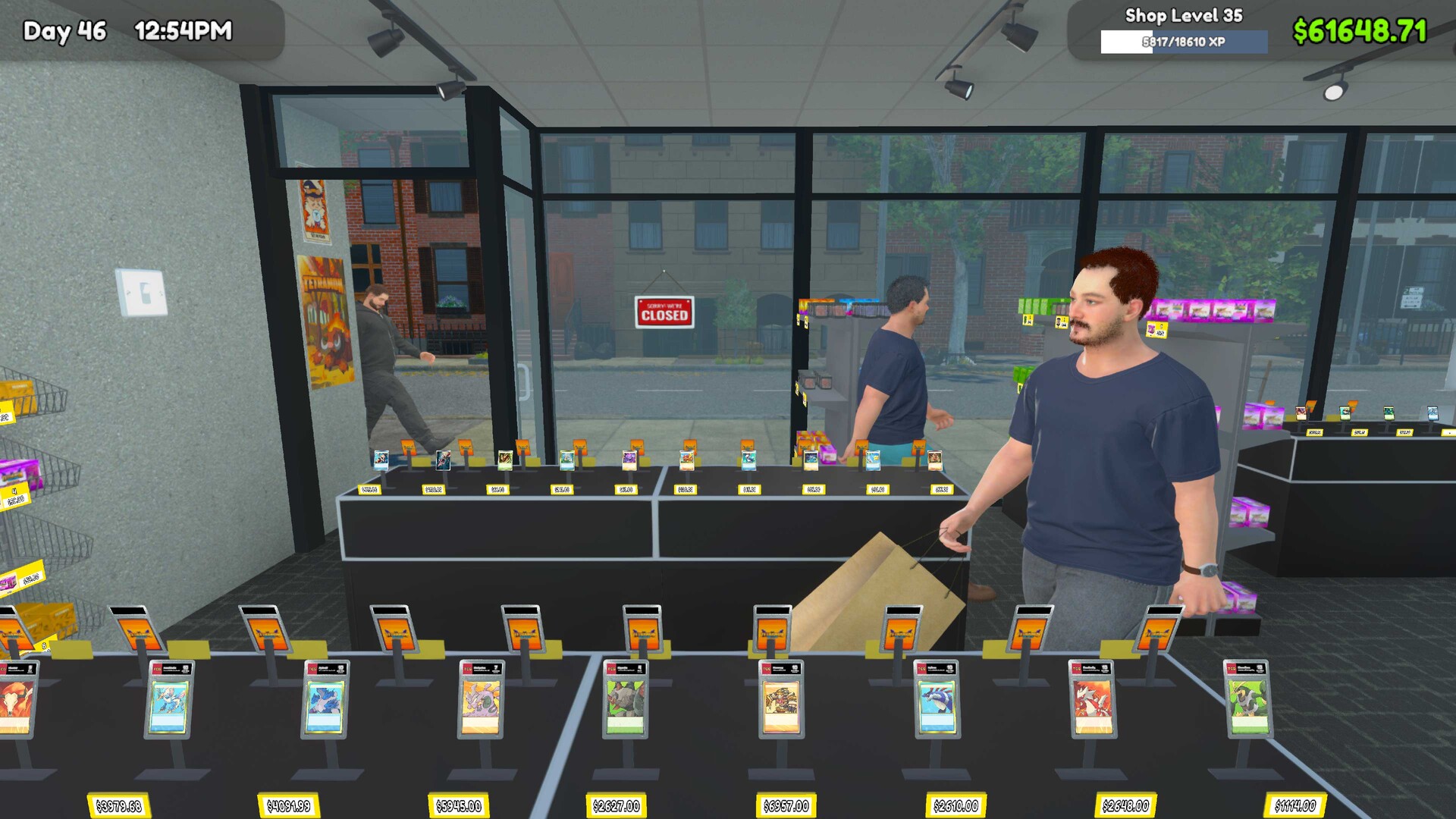 Official capture
 Direct answer
Cards stop selling when your markup beats the roll or the card is sitting in display-only furniture. Price at or below market, sell singles from a Card Table, and keep the listed products physically stocked on shelves.
Name the failure before you fix it
“Cards not selling” is three problems in one coat: no buyer appears, a buyer rejects your price, or the item sits in furniture that cannot sell. The wiki is unusually specific about all three, so work them in that order instead of cutting prices blind.
Lever one: the markup is a dice roll
Every item and card has a probability of selling based on how far your price sits above market. This is the table the wiki mechanics page records.
| Price against market | Chance of selling |
|---|---|
| 20% below | 100% |
| 10% below | 95% |
| At market | 90% |
| 10% above | 75% |
| 20% above | 60% |
| 30% above | 45% |
| 40% above | 15% |
| 50% above | 5% |
| 60% above | 1% |
| Beyond 60% above | 0% |
Treat it as a queue problem rather than a greed problem. A card at plus 40% still sells, but you need roughly seven encounters to clear one copy, and plus 50% needs about twenty. The cliff is between 30% and 40%, where the chance falls from 45% to 15% in one step, so pull slow movers back to plus 20% first.
Singles also sit in scarce slots, 10 on a $400 Card Table at level 3 and 12 on a $2,000 Vintage Card Table at level 25 per the wiki display tables, so an overpriced rare blocks the slot that would have paid.
Lever two: the furniture cannot sell
This one is invisible in the numbers: sleeved cards look correct standing on a display shelf, and customers will not buy them from it.
- Card Table ($400, level 3) and Vintage Card Table ($2,000, level 25) sell cards.
- Small Card Display, Card Display Table, Big Card Display and every Wall Display Case are display only. The wiki states they have no mechanical effect on the shop.
- Personal Shelves are a dead zone. Items there cannot be bought by customers or restocked by staff, so anything you parked on a $150 Small Personal Shelf is out of circulation.
- Sealed product has to sit on a Ware Display, cabinet or shelf to be purchasable, and each unit caps item types, from 3 on a Small Cabinet to 16 on a Double Sided Shelf.
Lever three: shoppers need your shelves to carry it
Customers can spawn with a shopping list drawn partly from what you stock, and the odds scale with level. The mechanics page records the breakdown.
| Shop level | List size | Minimum shelf items | Chance a customer arrives with a list |
|---|---|---|---|
| 1 to 2 | 3 | 3 | 5% |
| 5 to 9 | 3 | 3 | 15% |
| 10 to 19 | 4 | 5 | 25% |
| 20 to 29 | 6 | 7 | 30% |
| 30 to 39 | 7 | 9 | 40% |
| 50 to 59 | 10 | 13 | 50% |
| 70 plus | 12 | 15 | 60% |
Two things follow. Below level 10 almost every sale is an impulse buy off whatever is visible, so coverage beats precision. And when a listed item is missing, the customer walks to a random shelf and says they cannot find it, which reads as lost demand and is really a restock failure.
Lever four: wallets and the door cap
A customer cannot buy a $1,200 foil on a $60 wallet. Regular customers carry $20 up to a maximum the wiki computes as 100 plus 250 per main room expansion plus 100 per shop level, lot B adding 500 plus 400 per its expansions, capped at $30,000. Rich customers spawn 4.7% of the time at double that ceiling with a $40 floor, very rich ones 0.3% of the time at four times with a $300 floor. Expensive stock needs level and floor space before it clears, which is why a card that sat for a week suddenly moves.
Capacity matters too: the same page clamps the in-store customer count between 3 and 28, driven by unlocked rooms, shop level and half the play table sitters rounded up. More bodies need more registers, because customers look for a player manned register with an empty queue first, then an NPC manned one, then the shortest line.
Lever five: the market moves under you
Market prices are recalculated every night against the value an item was given when your save was created, not its current price. Play table events move their relevant card values by 0.2% to 5% first, then every item has a 40% chance to shift 0.8% to 2%, equally likely up or down.
Once an item sits more than 25% away from its initial value, a correction roll becomes possible with a probability equal to that distance, nudging it back by a random amount between 5% and the current gap divided by 2.1. The bounds are 20% below and 200% above the initial value.
So your reference price drifts and a markup that was safe last week can cross the 40% cliff on its own. Check the TCG Price app graph, which holds up to 30 days per item, before touching the sticker. Note too that an event fee above 60% markup brings the chance of a game happening to zero per the mechanics table, leaving you paying the daily event cost with nobody seated.
Diagnostic order that works
- Confirm the item is on a selling surface: ware display for sealed product, Card Table for singles.
- Compare your price to today’s market in the TCG Price app and move any card above plus 30% down to plus 20%.
- Restock the four product lines you can license at your level so the shopping list has targets.
- Read the Reviews app, which the community notes flags prices that read as too high or a smelly customer you missed.
- Only then look at throughput: registers, stockers and shelf capacity. Payback math sits in the staff guide and the worker payback tool.
What to do with the cards that still will not move
Bundle them. The Workbench builds bulk card bundles by expansion, rarity and price window, the only route that monetizes cards too weak to justify a table slot. Bundles sell slowly, and the per-save base values on the wiki price page run from $10.00 for a Tetramon Base low grade box to $250.00 for a Perfect Grade base box, with Destiny equivalents at $15.00 and $300.00. Cards worth grading belong in the grading guide instead, and pull expectations for replacement stock are on the pack odds tool.
Sources
Saved snapshots of every page cited, all fetched 2026-09-18:
- wiki.gg Mechanics and Formulas: https://tcgcardshopsimulator.wiki.gg/wiki/Mechanics_and_Formulas
- wiki.gg TCG Price: https://tcgcardshopsimulator.wiki.gg/wiki/TCG_Price
- wiki.gg Card Displays: https://tcgcardshopsimulator.wiki.gg/wiki/Card_Displays
- wiki.gg Personal Shelves: https://tcgcardshopsimulator.wiki.gg/wiki/Personal_Shelves
- wiki.gg Ware Displays: https://tcgcardshopsimulator.wiki.gg/wiki/Ware_Displays
- wiki.gg Play Tables: https://tcgcardshopsimulator.wiki.gg/wiki/Play_Tables
- wiki.gg Stock Order: https://tcgcardshopsimulator.wiki.gg/wiki/Stock_Order
- Fandom Workbench: https://tcg-card-shop.fandom.com/wiki/Workbench
- Fandom Phone: https://tcg-card-shop.fandom.com/wiki/Phone
- Steam announcement, TCG Card Shop Simulator 1.0 Update: https://steamstore-a.akamaihd.net/news/externalpost/steam_community_announcements/1843481262702357
Questions on this guide
Why does nobody buy my expensive cards?
Your markup probably beat the roll. The wiki mechanics table records a 90% chance to buy at market price, 45% at plus 30% markup and 5% at plus 50%, with anything above 60% at zero chance.
Do card displays sell cards in TCG Card Shop Simulator?
No. The wiki states that Card Displays let you show cards without customers being able to purchase them and that this has no mechanical effect. Only the Card Table and the Vintage Card Table sell singles.
Can customers buy from my personal shelf?
No. Items placed in a personal shelf cannot be purchased by customers and cannot be touched by staff, according to the wiki personal shelves page.
How far can a market price drift from its starting value?
The wiki TCG Price page records that an item cannot fall below 20% or rise above 200% of its initially calculated value, and that prices beyond 25% of that value attract a correction roll.
Source note: Every mechanic and figure in this guide traces to a saved copy of an official TCG Card Shop Simulator store page, developer news post, or community wiki record captured before publication. Anything the sources do not settle is marked rather than estimated. Corrections to [email protected].